

Introduction
Battery enclosures are often viewed as simple protective housings.
In reality, especially in Energy Storage Systems (ESS), battery enclosures are critical components that directly influence:
- System reliability
- Thermal performance
- Safety
- Long-term operating stability
For ESS applications, the challenge is not achieving the lightest design.
The challenge is achieving the most reliable one.
What Does an ESS Battery Enclosure Actually Do?
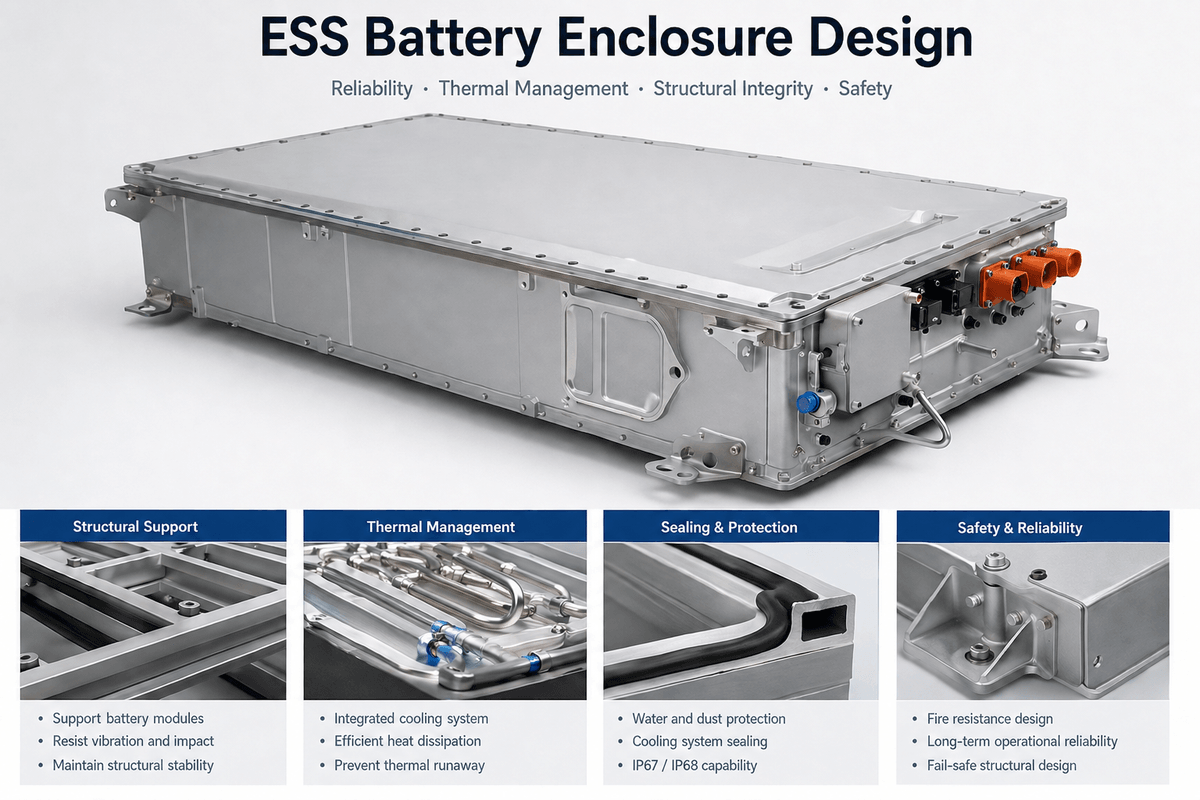
An ESS battery enclosure typically serves four key functions:
Structural Support
The enclosure must support modules, maintain dimensional stability, and resist vibration or deformation over long-term operation.
Thermal Management Support
Battery enclosures often integrate cooling systems, thermal interfaces, and heat dissipation structures.
Sealing and Environmental Protection
The enclosure protects against:
- Water ingress
- Dust contamination
- Cooling system leakage
System Safety
A failure in the enclosure may affect:
- Battery safety
- Cooling performance
- System uptime
Because of this:
Battery enclosures should be treated as reliability components, not simply structural components.
Why ESS Prioritizes Reliability Over Lightweighting
Unlike EV systems, ESS installations typically operate continuously.
Typical priorities for ESS battery enclosures are:
- Long-term reliability
- Sealing performance
- Manufacturing consistency
- Maintainability
- Weight optimization
This is why aggressive lightweight designs are often not the primary target.
Manufacturing Considerations for ESS Battery Enclosures
Selecting the manufacturing process should begin with system requirements.
Questions engineers often ask include:
- How critical is sealing performance?
- Where are the weld locations?
- Will cooling systems be integrated?
- Can leakage be inspected easily?
- How easy is maintenance?
🔷When Can Die Casting Be Used for Battery Enclosures?
Although die casting is widely used in automotive structures, its suitability for ESS battery enclosures depends heavily on system requirements.
Die casting may offer advantages such as:
- High production efficiency
- Complex geometry capability
- Reduced part count through integration
However, engineers should also evaluate:
- Internal porosity risks
- Leakage detectability
- Long-term sealing requirements
- Inspection difficulty for critical structures
For enclosure components with strict sealing and long-term reliability requirements, manufacturing selection should be evaluated from a system perspective rather than production volume alone.
Learn more about:
🔷Extrusion-Based Structures
Extrusion is commonly used when:
- Parts are long
- Cross-sections are repetitive
- Consistency is critical
Advantages include:
- Stable material properties
- Good consistency
- Cost-effective scaling
- Suitable for modular structures
Explore our
🔷CNC Machining for Critical Interfaces
CNC machining is often used for:
- Sealing surfaces
- Connection interfaces
- Tight-tolerance features
Learn more about:
Welding and Sealing Design
Poor welding locations often create hidden risks.
Good enclosure design should ensure:
- Inspectable sealing paths
- Clear structural boundaries
- Accessible leak testing
Reliability Starts at the Design Stage
A common misconception is:
Better performance always means better design.
For ESS battery enclosures:
Predictability and reliability are often more valuable than aggressive optimization.
Conclusion
Different manufacturing routes may lead to very different reliability outcomes, even for the same enclosure design.
When designing ESS battery enclosures, the goal is not simply to create a lighter enclosure.
The goal is:
Building a structure that supports long-term operation, stable thermal management, and predictable reliability.